You finish talking. A few seconds later there’s a file on disk — titled, summarised, transcribed — and it’s a plain markdown file you own. No spinner waiting on a server, no account, nothing uploaded. That moment is the whole reason SR-7 exists.
SR-7 exists because the gap between having a thought and capturing it is too wide. Typing is a tax on thinking. By the time you’ve opened a note and started writing, the shape of the idea has already changed. Speaking doesn’t have that lag — speech tracks the thought as it forms, and you can do it walking, driving, or staring out a window. Lower the barrier to capture and you simply capture more. A lot of good thinking happens out loud, then evaporates the moment you stop talking, because writing it down means stopping to write it down.
What it does
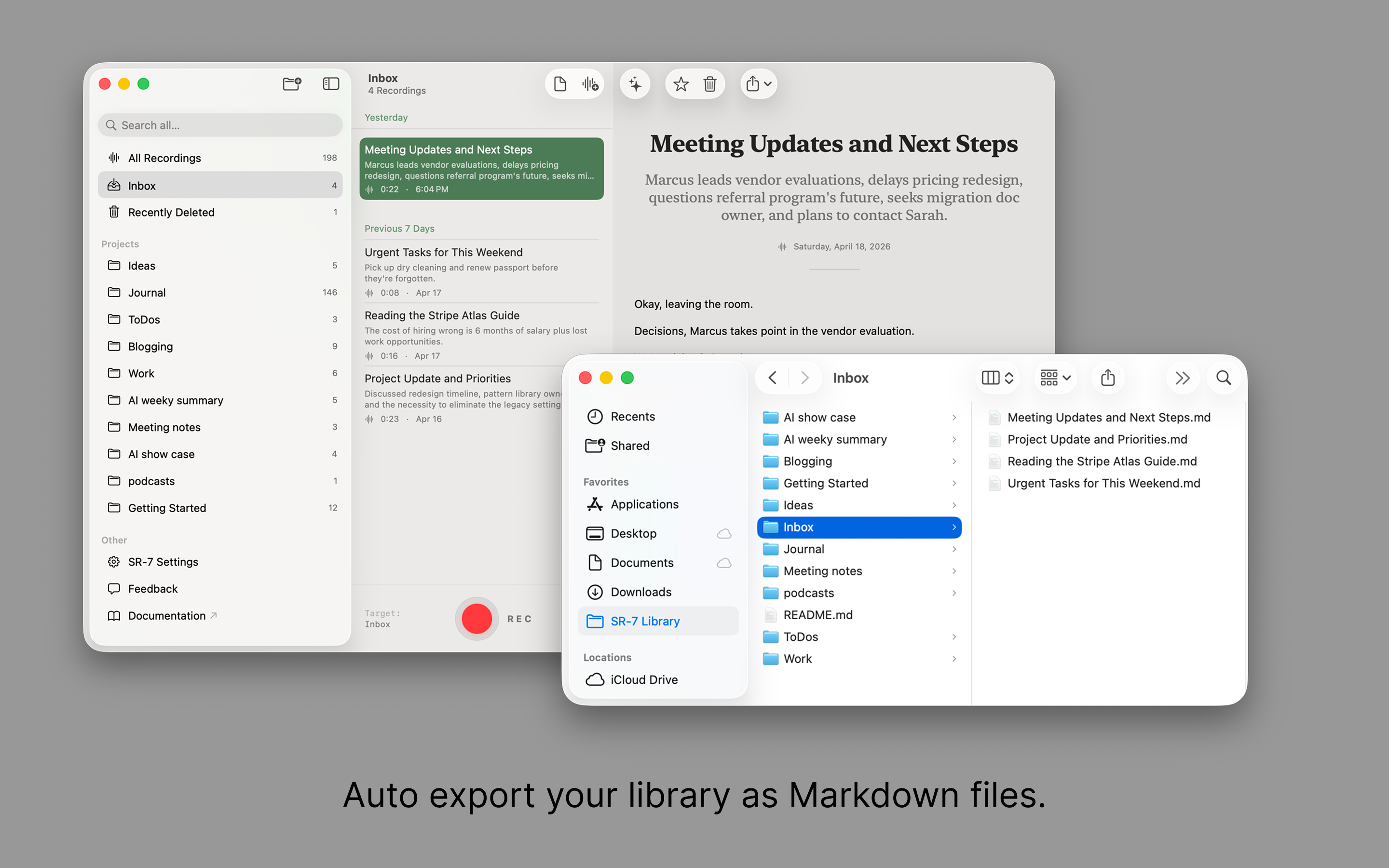
SR-7 is a voice recorder for Mac and iPhone. You hit record, you talk, you stop. On-device it transcribes the audio, writes a title, and drafts a short summary. The result is a markdown file with YAML front matter — title, summary, and full transcript — sitting in a folder.
That file is the product. Not a row in someone’s database, not an export you have to remember to run. The recording is a document, written in the most durable format there is.
The interface is part of how it works
Werkstatt means workshop, and Field Bureau builds software the way a workshop builds tools — craft and design carry real weight here, down to how a recording feels to make. Hit record and a reel-to-reel deck starts turning while a live waveform moves with your voice.
The animation earns its place. A recorder’s first job is to be trusted: you need to know, without thinking about it, that the thing is actually capturing. Turning reels and a moving waveform answer that at a glance, the way the spinning spools of a tape deck always did — no status text to read, no indicator to hunt for. It says what matters, then gets out of the way.
That restraint is deliberate. Less, but better. A tool you think in has to stay quiet enough to keep you in the moment, because the instant it pulls at your attention the thought you were chasing is gone. SR-7 is shaped like a piece of field equipment for that reason: honest, tactile form that looks like what it is, reassures by being legible, and leaves your head free for the idea instead of the app.
Everything happens on your machine
Transcription runs on Apple’s Speech framework. Titles and summaries come from FoundationModels, the on-device model that ships with macOS 26. Both run locally, which means a recording never leaves your device for any of the parts that matter.
This matters for boring, practical reasons. Recordings are often the most candid thing you produce all day — half-formed ideas, things you’d never put in a doc yet, a quick rant about a decision. Sending all of that to a third party to get a transcript back is a bad trade. Keeping it local removes the question entirely: there’s no consent dialog to read, no terms to trust, no breach to worry about, because the audio never goes anywhere. It also means the recorder works on a plane, in a basement, with the wifi off. We’ve written more about that reasoning in Why On-Device Beats the Cloud for Thinking Tools.
The markdown file is the point
Every recording exports as markdown with structured front matter. That sounds like a small implementation detail and it’s actually the design.
A markdown file with front matter is readable by you, by a text editor, by git, and by every AI tool you already use. There’s no SR-7 format to be locked into and no SR-7 cloud to be evicted from. The recording outlives the app. This is the thread that runs through everything we make.
Your archive, answerable
SR-7 ships a local MCP server on macOS. That means the same AI you already code with — the one in your editor, in Claude Code, wherever you live — can search your recording archive directly. You can ask “what did I decide about the pricing model last week?” and get an answer drawn from your own voice notes, with the actual recordings cited. Nothing gets uploaded to make that work; the model reads files on your disk through a local connection.
A pile of recordings turns into something you can interrogate. Months of thinking-out-loud becomes a corpus your tools can read. We dug into what that unlocks in Your Recordings as Context.
Sync, if you want it
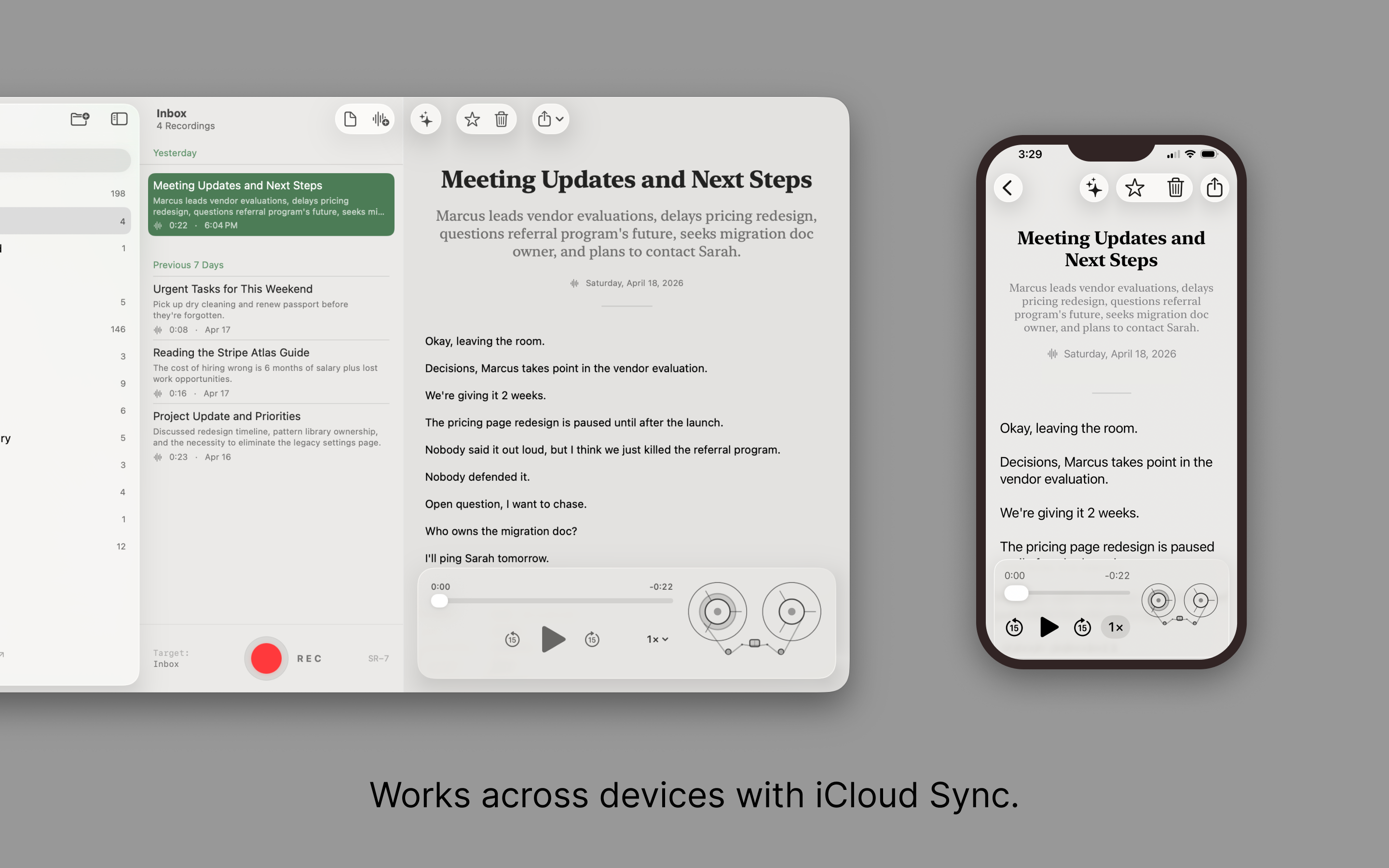
Recordings can sync across your devices through your own iCloud. Start a thought on the phone walking home, find it on the Mac. That’s optional, and it’s your iCloud — there’s no server of ours in the middle. If you’d rather keep everything on one machine, leave sync off and nothing changes about how the app works.
Compared to what’s out there
Most transcription tools route your audio through a cloud service, charge monthly, and hand you a transcript trapped behind a login. SR-7 keeps the audio local, charges once, and gives you a file.
Price
SR-7 is $7.99, one time. One purchase covers both Mac and iPhone — it’s a universal app. No subscription, no upgrade tiers, no account to maintain. You buy it, it’s yours: the app, your recordings, and the version you paid for.
That $7.99 is an introductory price. It will go up later. There’s no countdown and no pressure — we’d rather tell you plainly than spring it on you down the line.
What you need
SR-7 needs macOS 26 or iOS 26. The on-device AI — the titles, the summaries, the FoundationModels work — needs Apple Silicon. The recorder itself is light; the intelligence is what asks for the newer hardware.
SR-7 is the kind of recorder we wanted to use: fast to capture, private by default, and leaving behind files you’ll still be able to open in ten years. You talk, and a few seconds later there’s a document you own.
Take a look at SR-7.